
What's Keeping You From Hiring a CEO Coach?


You have a top-notch C-Suite. You also have an attorney, an accountant, a banker, maybe a wealth advisor. Depending on the size of your company, you may have a bank of consultants crawling all over the place.
You hire smart people because you understand that you don’t know everything. Nor do you need to.
And then we get to you.
The CEO.
Oh, now that’s a different story.
Maybe you’ve got an MBA, or maybe a Leadership Certificate from Harvard or Wharton.
But think about it. There really isn’t a CEO curriculum or degree.
It’s “on-the-job” training.
You are supposed to figure this part out on your own.
More than a decade ago, Stanford Graduate School of Business and The Miles Group found that nearly two-thirds of CEOs weren't receiving outside coaching or leadership advice, even though virtually all of them said they were receptive to seasoned outside counsel.
But things are changing.
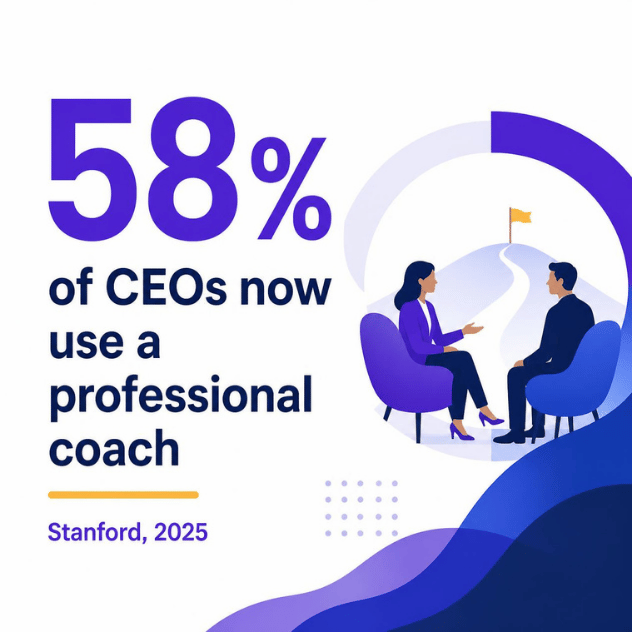
In Stanford's 2025 follow-up research, 58% of CEOs said they now use a professional coach to discuss business, leadership, and self-development.
That's significant. CEO coaching is no longer something executives whisper about because the board thinks they need "fixing." It has increasingly become part of the infrastructure serious leaders build around themselves.
“The stigma around asking for help has lifted. Whereas historically it might have been seen as a sign of weakness or uncertainty for business leaders to ask for help, CEOs and directors today are much more comfortable, even eager, to canvass friends and engage professional coaches to sharpen their skills, to make sure they have the full range of knowledge to solve thorny organizational problems. The stereotype of the self-sufficient CEO is being replaced by a recognition that no one has to go it alone.”
Professor David F. Larker
Stanford Graduate School of Business and
The Hoover Institution at Stanford University
And yet, about four out of ten CEOs still don't have a professional coach.
So, what's keeping you from hiring one?
Maybe one of these sounds familiar.
I don't need a CEO coach.
Fair enough.
Maybe you don’t. You got this far without one.
But remember Marshall Goldsmith’s book “What Got You Here Won’t Get You There?”
You built the business. Survived the pandemic. Hired people. Fired people. Made payroll when you weren't sure you could. Won customers you weren't supposed to win. Made decisions with incomplete information and occasionally got it right.
Why would you need somebody sitting across from you asking questions?
But that's not the right question.
The question isn't whether you are capable of running your business without a coach.
Obviously, you are.
The question is whether you would think, decide, and lead better with someone whose job is to challenge your thinking.
Those are very different questions.
Nobody watches Scottie Scheffler play golf and concludes that coaching is unnecessary because he is better than his coach.
Elite performers don't generally use coaches because they are incompetent.
They use them because competence creates blind spots, and those blind spots can blind you to your own blind spots. Is that the blind leading the blind? In this case, ourselves?
Success reinforces the behaviors, practice, disciplines, and mindsets that got you here. Some will take you where you want to go next.
Some won't.
It can be surprisingly difficult to tell which is which when you're sitting inside your own head.

I already have a great executive team.
Good.
But your executive team cannot completely solve the problem.
Your CFO may disagree with you. Your COO may challenge you. Your CRO may tell you something you don't particularly want to hear.
But each of them still reports to you.
An unavoidable power asymmetry exists in the relationship.
They have careers, compensation, political capital, departments, and agendas to protect. That doesn't make them dishonest. It makes them human.
It also means some conversations become harder once you become CEO.
Harvard Business Review has examined the peculiar loneliness CEOs experience. It isn't necessarily because they have too few people around them. CEOs can spend their entire day in meetings and still be isolated.
CEO isolation comes from the weight and asymmetry of the role.
There are decisions you ultimately own.
You can't always dump your fears on your employees.
There are doubts you may not want to share with your board.
Sometimes the person whose judgment needs examination is the one everyone else relies on.
That's you.
A great CEO coach is not your friend. They are there to drive you forward, to elevate your performance, to serve as a sounding board and ultimately make you better.

I have friends and other CEOs I talk to.
In fact, Stanford's 2025 study found that 82% of CEOs rely on friends, acquaintances, and personal contacts for informal advice.
Having your own kitchen cabinet is invaluable. A CEO peer group like the CEO Matters Roundtable can be an essential part of that support structure. It’s a room full of CEOs who sit in the same chair and have no reason to filter what they say.
But friendship and coaching serve different purposes.
Your friends love you.
Your peers may understand you.
Your advisors may know your business.
But a good CEO coach has a different assignment.
The coach isn't there to reassure you, to agree with you, to solve the problem for you, or tell you what they did as CEO.
The coach creates a safe space where you can explore your own thinking, narratives, blind spots.
What aren't you seeing?
What conversation are you avoiding?
Where is your ego sitting in the decision?
That conversation is different from having a beer with a CEO friend.
Both matter.
They're just not the same thing.

I don't have time for CEO coaching.
This one always fascinates me.
The CEO doesn't have an hour or two a month to think about how they're performing.
Think about that for a moment.
Your company may spend tens of thousands of hours on execution every month.
And the person whose decisions shape all those hours can't find 90 minutes to assess their quality.
That is not a time-management problem.
It is a prioritization problem. Or maybe, an ego problem.
CEO coaching shouldn't create another meeting you have to endure.
Done well, it should improve the quality of everything that happens between meetings.
One better hiring decision can matter.
One decision not to chase the shiny object can matter.
One candid conversation with an executive you've been avoiding can matter.
The multiplier is enormous because the CEO has significant leverage.
Your calendar is one of the clearest statements you make about what matters.
If developing the CEO never makes the calendar, that tells you something.
I'm not sure CEO coaching is worth the money.
You shouldn't hire a coach because coaching sounds trendy.
You should expect a return on your investment of time and money in professional coaching just as you would with any other investment. And there are both direct and indirect benefits to consider:
What is the value of avoiding the wrong executive hire?
What does keeping a key executive who was preparing to leave save you?
What is it worth to make a consequential decision two months earlier because your thinking became clearer?
Some coaching outcomes are directly measurable. Others affect judgment, behavior, relationships, energy, and decision quality, then show up downstream in the business.
According to PwC and the International Coaching Federation, 86% of companies that track their coaching outcomes report a clear financial return, typically recovering 5 to 7 times their original investment.

You and your coach should know what you're working on and what better looks like.
But don't make the mistake of measuring the cost of coaching precisely while pretending the cost of poor CEO decisions is zero.
I've met CEO coaches. I wasn't impressed.
Yeah, some of them suck.
The bar is pretty low. No real certification requirements.
Their dog pays attention, so they hang out their “CEO Coach” shingle.
But honestly, it doesn’t take long to figure out whether a coach is providing you with personalized value.
As a Hogan-certified coach, I use validated assessment tools to identify behavioral patterns that show up under stress, pressure, and fatigue, because every CEO has derailers, and most don't know what theirs are.
But chemistry is also important.
So is judgment.
So does the coach's willingness to disagree with you.
And for CEO coaching specifically, I place considerable value on understanding what being a CEO actually feels like.
A CEO coach doesn't necessarily need to have run your kind of company, but the coach should understand the ambiguity, isolation, pressure, responsibility, and occasional absurdity of being the person where the buck actually stops.
Most importantly, don't hire a coach who is overly impressed by you.
You have enough people who will nod. Like your dog.
You don't need another one.
You need somebody you trust enough to say:
I think you're wrong.
And then help you figure out whether you are.
If you're wondering how to choose the right CEO coach, I wrote a detailed guide on what to look for and what to avoid.

What would I even talk to a coach about?
What’s on your mind right now?
Seriously.
Forget the grand leadership transformation.
Which decision are you wrestling with?
Who is frustrating you?
What isn't getting done?
What conversation do you know you need to have?
That's where CEO well-being meets CEO performance. They aren't separate things. Your personal life and your leadership are running on the same brain, the same energy, the same patterns.
CEO Mental Fitness is about how your brain actually handles stress, focus, and decisions. It’s your company's most valuable leadership asset.
Yes, there may be assessments, goals, frameworks, leadership development, accountability, behavioral change, strategic conversations, and all the other things coaching websites like to talk about.
But the real work tends to begin with something much more immediate:
What's going on, and how are you showing up in it?
Because you are always part of the equation.
Hiring a coach feels like admitting weakness.
This may be the biggest one.
Not because CEOs say it out loud.
They usually don't.
But the old model of executive coaching carried baggage.
Coaching was remedial.
That stigma hasn't completely disappeared, but it is increasingly obsolete.
Today, many successful CEOs hire coaches for precisely the opposite reason.
They are good at what they do.
And they want to get better.
The transition mirrors what happened in professional sports decades ago.
Nobody assumes an Olympic athlete has a coach because something is wrong with them.
Bob Bowman coached Michael Phelps to 23 Olympic gold medals.
The coach is there because fractions matter at the highest level of performance.
They matter in leadership too.
The more successful you become, the more dangerous your blind spots become.
Early in your career, feedback is everywhere.
You have bosses.
Mentors.
People correcting you.
People telling you no.
Then you become CEO.
And the flow reverses.
Instead of receiving information, you're constantly asked for answers.
Instead of being evaluated every day, you evaluate everybody else.
People laugh a little harder at your jokes.
Ideas you casually mention have an uncanny habit of becoming projects.
Employees begin editing what they tell you.
Bad news takes longer to travel up the chain.
Your experience gives you pattern recognition, but it can also make you too certain that you've seen this movie before.
That is the paradox of CEO success.
A CEO coach should be one of those people.
Someone who helps you slow down when you're moving too fast, move when you've been thinking too long, see the pattern you keep repeating, and separate what you know from what you merely believe.
The Real Question
Seriously, what are you afraid of?
Maybe the question isn't whether you need a CEO coach.
You may not.
Is it really the money? Or the time?
Or are you reluctant to build a relationship where someone has permission to challenge the stories you tell yourself?
Because that's where CEO coaching gets interesting.
Not when someone gives you the answer.
It’s when the coach helps you discover that you've been asking the wrong question.
And perhaps the first question is this one:
What's keeping you from hiring a CEO coach?
Frequently asked questions about hiring a CEO coach
Why do CEOs hire coaches? CEOs hire coaches not because they're struggling, but to think more clearly, decide more effectively, and lead without blind spots. Stanford's 2025 research found that 58% of CEOs now work with a professional coach. The higher the stakes, the more valuable it becomes to have someone whose only job is to challenge your thinking.
How do I know if I need a CEO coach? If you can't name one person in your life who regularly tells you the uncomfortable truth without an agenda, you likely need a coach. If you're making decisions in isolation, carrying stress nobody knows about, or sensing your company has hit an unexplained ceiling, a coach can help you see what you're missing.
What's the difference between a CEO coach and a mentor? A mentor shares their experience and gives advice based on what worked for them. A CEO coach helps you examine your own thinking, patterns, and blind spots. Mentors tell you what they would do. Coaches help you figure out what you should do and why you haven't done it yet.
Is CEO coaching confidential? Absolutely. Confidentiality is the foundation of the coaching relationship. Without it, there is no candor. Without candor, coaching doesn't work. Ask any coach you're considering how they handle confidentiality before you begin.
How long does CEO coaching take to show results? Most CEOs notice shifts in their thinking and decision-making within the first few sessions. The deeper work: changing long-held patterns, improving relationships, building sustainable leadership practices unfolds over months. My clients typically work with me for years because the value compounds as the relationship deepens.
What is CEO Mental Fitness? CEO Mental Fitness is how your brain handles stress, energy, focus, and decisions under pressure. It's not a mindset; it's the operating system your leadership runs on. Coaching helps you protect and strengthen that system so you make your best decisions when the stakes are highest.
Liam Chrismer is the founder of Chrismer CEO Consulting, a Hogan-certified executive coach, and an Official Member of Forbes Coaches Council. His book, CEO Mental Fitness, is coming from Fast Company Press in 2027.


Comments