
The CEO Who Reads Is the CEO Who Thinks Better: Why Reading Belongs in Every CEO's Mental Fitness Discipline


When was the last time you read a book that had absolutely nothing to do with your business? I'm not talking about the latest leadership book you snagged at Hudson News on your last trip or the book David Senra summarized on the Founders podcast. Something different. A novel. A biography. History. Philosophy. Perhaps something that challenged a belief you've held for years.
CEOs spend enormous amounts of time consuming information: emails, financial reports, dashboards, articles, presentations, podcasts, and an endless stream of digital content. But consuming information isn't necessarily the same as developing your mind.
And that's what's important to your leadership.
Reading isn't simply a way for CEOs to acquire knowledge. It's a discipline that strengthens the brain they rely on to lead.
Reading Is a CEO Mental Fitness Practice
CEO Mental Fitness is your capacity to lead, your perception to see what others miss, and your ability to make decisions. Reading belongs squarely in that discipline.
When you read a challenging book, you are engaging your brain. You concentrate, follow a storyline or argument, hold ideas in working memory, and connect new information with what you already know.
Unlike scrolling through LinkedIn, reading a substantive book requires sustained cognitive engagement. And that's precisely why CEOs should do more of it.
Reading engages many of the cognitive capabilities essential to leadership: attention, comprehension, reasoning, memory, and pattern recognition.
A 2024 meta-analysis in the Journal of Experimental Psychology: General examined the cognitive effects of reading fiction. The researchers found small but measurable benefits, particularly in empathy and understanding others' mental states. Longer-term exposure to fiction was also associated with stronger verbal abilities.
The effects aren't enormous, and the research doesn't prove that reading automatically makes someone a better leader. But it does suggest that reading exercises capabilities CEOs use every day.
The CEO Who Collects Lessons, Not Books
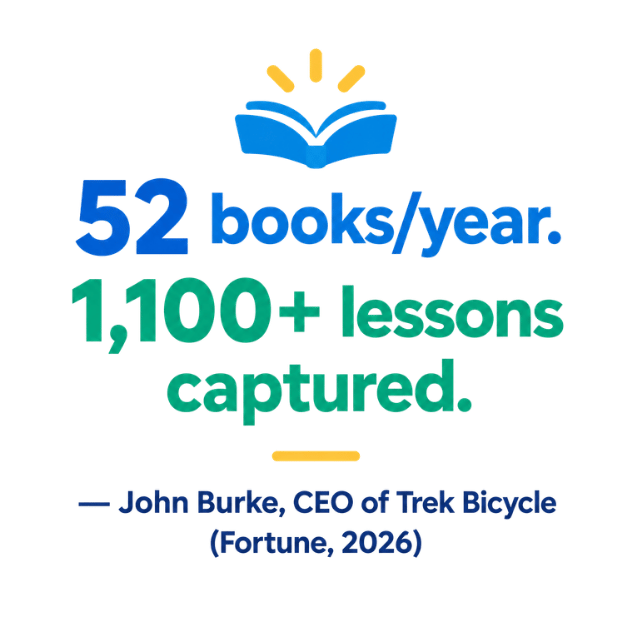
John Burke has led Trek Bicycle through changing markets, economic downturns, and an extraordinarily competitive industry. What caught my attention was a Fortune report from May 2026. Burke reads approximately 52 books a year.
Impressive? Yes. But he takes it to another level.
He maintains a spreadsheet containing more than 1,100 lessons extracted from his reading.
I'm envious.
He's built a personal repository of ideas accumulated from other people's research, experiences, mistakes, and insights. And he deliberately captures the lessons he wants to remember. This goes way beyond recreational reading. I'd call it intellectual capital formation.
A CEO who captures and revisits meaningful ideas builds something far more valuable than a bookshelf.
He's building a better-equipped mind.
Reading Expands Perspective
One of the greatest hazards of being a CEO is that your world gradually becomes smaller. I know that sounds counterintuitive. After all, CEOs encounter more people, information, and decisions than most of us. But much of that information comes through the same organization, the same industry, and the same familiar assumptions. Eventually, those assumptions begin to feel like facts.
Books can interrupt that process.
David Risher, Lyft's CEO, offers an interesting example. In a 2026 interview with Barry Ritholtz, Risher discussed reading both fiction and nonfiction. His selections included Apple in China, which examines Apple's complicated relationship with China, and Good People, a novel about an Afghan family in America. Risher specifically discussed how fiction can teach empathy and expose readers to different perspectives.
This offers an important leadership lesson.
A book about Apple might illuminate supply-chain dependencies and geopolitical risk. A novel about an immigrant family might challenge assumptions about human behavior.
Both can make a CEO a more perceptive observer of the world.
CEOs don't simply need more information.
They need more ways of interpreting the information they already have.

Reading Can Make You a Better Communicator
CEOs lead through language. They articulate strategy in leadership meetings. They explain difficult decisions, ask questions, provide feedback, and resolve conflict. In many ways, they inspire people to pursue something they cannot yet see. And words are the tools they use.
Reading exposes us to different vocabularies, sentence structures, arguments, metaphors, and storytelling techniques. But the benefit isn't simply acquiring more sophisticated words. Reading helps us express complicated thoughts with greater precision and simplicity. It equips us with the ability to communicate clearly.
Consider the difference between a CEO who says, "We need to improve operational efficiencies," and one who can explain exactly what must change, why it matters, and how employees will benefit. One communicates corporate language. The other communicates meaning. One informs and the other inspires.
Good writing can teach us how to organize an argument, create an image in someone's mind, and make an idea memorable. For CEOs, these practices build leadership capacity.

Reading Helps CEOs Recognize Themselves
Leadership can be profoundly isolating. Few people inside an organization fully understand the pressures, uncertainty, and personal doubts a CEO experiences. This is what I call CEO isolation the conversation that never happens.
And fewer still are invited into those conversations.
Medina Baitemirova, founder of the healthcare startup Clinicai, described returning to books when entrepreneurship and being a female immigrant felt lonely. In a Fast Company interview, she discussed revisiting books that restored her inspiration and confidence. Sometimes we read to discover something new about the world. Other times, we read to discover something about ourselves.
A biography can remind a struggling CEO that even extraordinary leaders experience failure. A novel can illuminate human motivations. A philosophical work can challenge how we define success.
Reading offers something hard to find in the executive suite: the chance to reflect without having to perform.
Reading Is the Antidote to Intellectual Complacency
Perhaps one of the most dangerous moments in a CEO's career isn't when they don't know enough. It's when they believe they already know enough. Success reinforces existing beliefs. Experience can harden into certainty. Confidence can quietly become intellectual arrogance.
This is why CEO mental fitness matters. It's not about working harder. It's about staying sharp, curious, and open.
Reading widely provides a corrective.
History reminds us that today's problems often have precedents. Science reminds us how much we still don't know. Philosophy teaches us to question our assumptions. Fiction reminds us that other people experience the world differently.
The purpose isn't to become the smartest person in the room. Rather, it is to remain the most intellectually curious.
Make Reading a Discipline, Not an Aspiration
It's not necessary to match John Burke's 52 books a year. Although it certainly wouldn't hurt you. Start with 20 minutes a day. That's more than 120 hours of reading annually.
Read outside your industry. Alternate business books with biographies, history, fiction, and science.
And it's not only about finishing books. Capture what matters.
After every book, ask yourself three questions:
1. What did I learn that I didn't know before?
2. What belief or assumption did this book challenge?
3. What will I think or do differently because I read it?
A book's value isn't measured by the number of pages you've turned. It's measured by what stays with you after you've closed it.
Your company can only be as thoughtful as the person leading it is willing to become.
Sometimes, becoming a better CEO starts with opening a book.
If you're ready to invest in the mental fitness practices that separate great CEOs from the rest, I'd love to talk. Schedule a call and let's start the conversation.
FAQ: Why CEOs Should Read
Why should a CEO read books instead of just consuming articles and podcasts?
Books require sustained cognitive engagement that articles and podcasts don't. Reading a full book strengthens attention, comprehension, reasoning, and pattern recognition cognitive capabilities CEOs rely on every day. A 2024 meta-analysis confirmed that reading fiction produces measurable cognitive benefits, particularly in empathy and verbal abilities.
How many books should a CEO read per year?
There's no magic number. Trek Bicycle CEO John Burke reads 52 books a year and maintains a spreadsheet of over 1,100 lessons. But even 20 minutes a day roughly 120 hours annually can make a meaningful difference in a CEO's cognitive fitness and leadership capacity.
What types of books should CEOs read?
CEOs benefit most from reading outside their industry. Alternate between business books, biographies, history, fiction, philosophy, and science. Fiction builds empathy and perspective. History reveals precedents for today's challenges. Philosophy teaches leaders to question assumptions.
How does reading improve CEO decision-making?
Reading exposes CEOs to different frameworks, mental models, and ways of interpreting information. It counteracts the intellectual complacency that comes with success and experience, keeping leaders curious and open to new ideas qualities essential to strong decision-making.
Is reading part of CEO mental fitness?
Yes. CEO Mental Fitness is the capacity to lead, perceive what others miss, and make sound decisions. Reading is a discipline that exercises the cognitive capabilities underlying all three: attention, comprehension, reasoning, memory, and pattern recognition.
Liam Chrismer is a CEO Mental Fitness coach based in Denver, Colorado. He works with CEOs and founders who want to lead with greater clarity, resilience, and purpose. Through one-on-one coaching, the CEO Matters Roundtable peer group, and the Hogan Assessment, Liam helps leaders strengthen the mental fitness practices that drive better decisions and stronger organizations. Learn more about working with Liam →


Comments